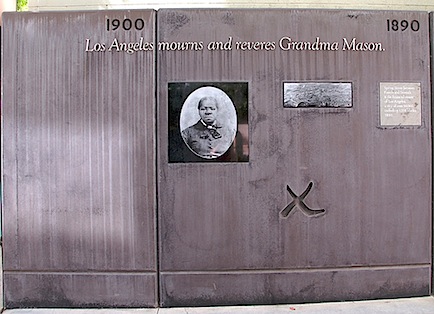
I recently discovered Biddy Mason: a midwife, entrepreneur, landowner and philanthropist on Spring Street in downtown Los Angeles, and a founder of the First African Methodist Episcopal Church, a major black church.
She gives me strength. Her life speaks for itself.
Bridget "Biddy" Mason
August 15, 1818 - January 15, 1891
Bridget was born a slave, that much is certain. Some sources say she was born on the plantation of Robert Marion Smith and Rebecca Crosby Smith. Another source says she was born on a plantation in Hancock, Georgia, and that around 1836, she and her sister Hannah were purchased by Robert and Rebecca Smith and taken to their plantation in Logtown, Mississippi.
As a slave, Bridget had no formal education. She did learn about midwifery and herbal medicines from the other slave women and healers, and became well-regarded as a midwife.
In 1847, Robert Smith became a Mormon and moved, with his household and slaves (90 people in all), to Utah Territory. On this arduous 2,000-mile trek across the country, Biddy's responsibility was to herd the cattle, prepare meals, act as a midwife, and take care of her own children. (She had three daughters, Ellen, Ann and Harriet, whose father was reputedly Smith.) In 1851, Smith moved everyone again to San Bernardino, California, where Brigham Young was starting another Mormon community.
Biddy learned through friends in the African-American Los Angeles community that California had been admitted to the Union in 1850 as a free state; slavery was prohibited. But such slave owners were rarely challenged, and if they were, they rarely lost the case. In the winter of 1855, Smith decided to move once again, to Texas, a slave state. Their departure was interrupted by the Los Angeles sheriff, who served Smith a writ of habeas corpus on behalf of Biddy.
Biddy's daughter Ellen had been dating a free black man, Charles Owens, the son of an esteemed business owner in Los Angeles' African-American community. Charles and his friend Manuel Pepper, who was dating the daughter of another of Smith's slaves, helped Biddy file her petition with the court for her freedom. Since California law at the time prohibited blacks, mulattos and Native Americans from testifying in court, Biddy could not speak on her own behalf, but the judge did meet with her privately to hear her story. Robert Smith did not appear in court so, on January 19 (another source says January 21), 1856, the judge granted Biddy her freedom, as well as that of her three daughters (some sources say all the other slaves of Robert Smith were freed as well).
Biddy moved to Los Angeles, accepting the invitation to live with the Owens family. (Her daughter Ellen later married Charles.) She quickly became well regarded as a nurse and midwife, assisting in hundreds of births to mothers of all races and social classes. A couple sources say she was immediately offered a job after the trial by Dr. John S. Griffin, a Los Angeles doctor who had become interested in the case. What is certain is she soon became financially independent, saving her money and living frugally. Ten years later, in 1866, she bought a house and sizeable property on Spring Street for $250 -- becoming one of the first black women to own land in Los Angeles. She instructed her children to never abandon it.
In 1884, Biddy sold a parcel of the land for $1500 and built a commercial building with rental spaces on the remaining land. The area ultimately became the central commercial district of Los Angeles. Through continued wise business and real estate decisions, she acquired many parcels of land that, as the town developed, became prime urban lots -- and she accumulated a fortune of almost $300,000. Her grandson, Robert Curry Owens, a real estate developer and politician, was the wealthiest African-American in Los Angeles at one time.
 |
Biddy Mason's House of the Open Hand
|
Biddy became known as Grandma Mason -- generously donating money to charities (she would occasionally pay the expenses of both Black and white churchs), visiting prison inmates with gifts and aid, and giving food and shelter to the poor of all races. Needy people often lined up in front of 331 South Spring Street. One source says she also ran an orphanage in her house.
In 1872, Biddy and her son-in-law, Charles Owens, founded and financed the Los Angeles branch of the First African Methodist Episcopal Church, the first black church in Los Angeles. It is now known as 8th and Townes, and is presently housed in a modern building at 2270 South Harvard Street.
Biddy died January 15, 1891, at the age of 73, and was buried in an unmarked grave at Evergreen cemetery in the Boyle Heights area of Los Angeles. Nearly a century later, her accomplishments were finally given due respect when a tombstone marked her grave for the first time in a ceremony attended by Mayor Tom Bradley and about 3,000 First A.M.E. Church members, on March 27, 1988. The following year, November 16, 1989, was declared Biddy Mason Day and a memorial of her achievements was erected at the Broadway Spring Center (a parking garage built at the site of her home), between Spring Street and Broadway at Third Street.
 |
| Memorial Wall |
Source